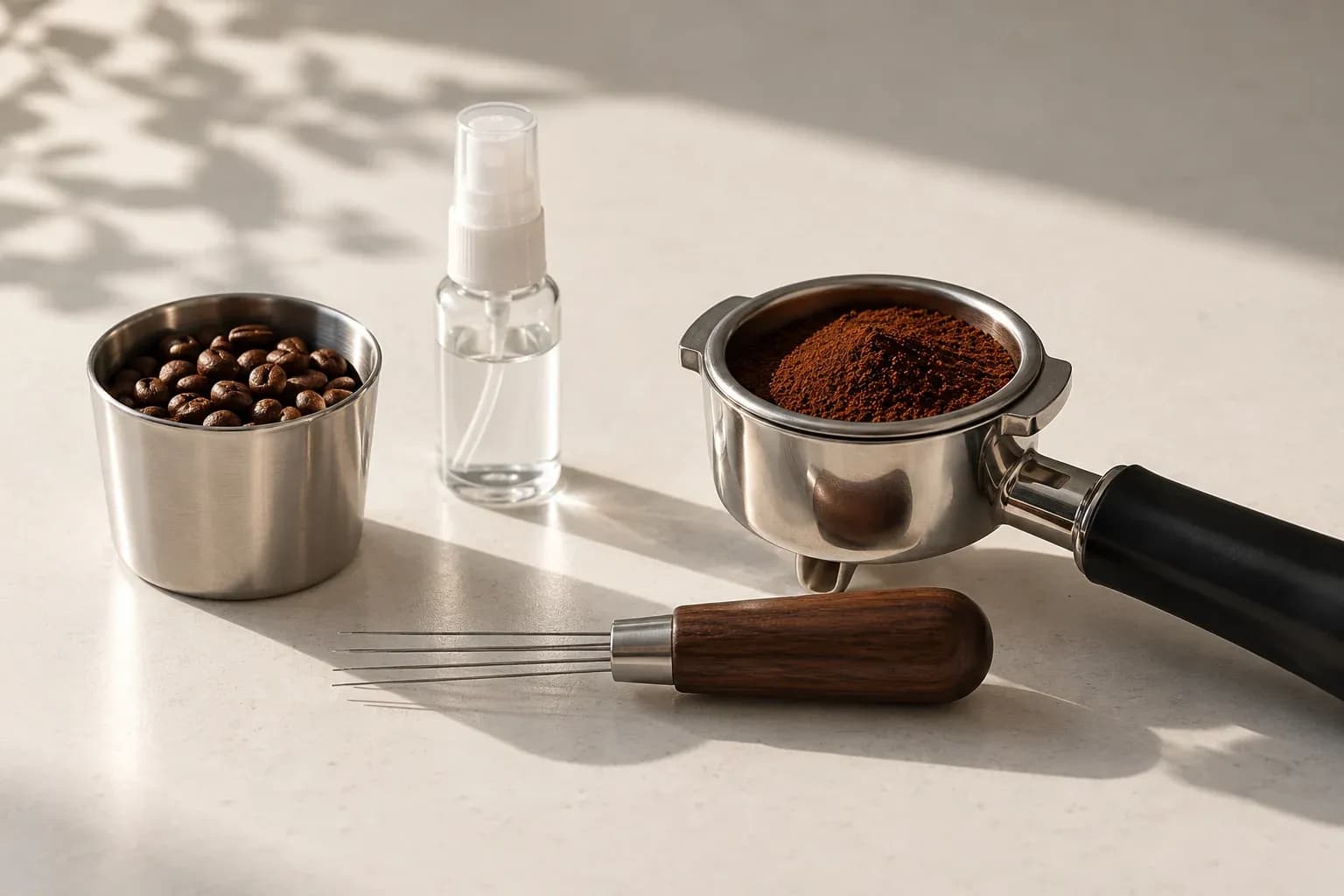
You shake a dosing cup, tip the grounds into the basket and notice that the next espresso runs differently. The movement is easy to add to a routine. Explaining what it did is harder.
Shaking can break some visible clumps, move particles relative to one another and change how the dose leaves a container. Those effects are not interchangeable. A tidy, fluffy-looking pile does not establish that fine particles have been removed, evenly distributed or placed where you want them.
Fine particles belong to a distribution
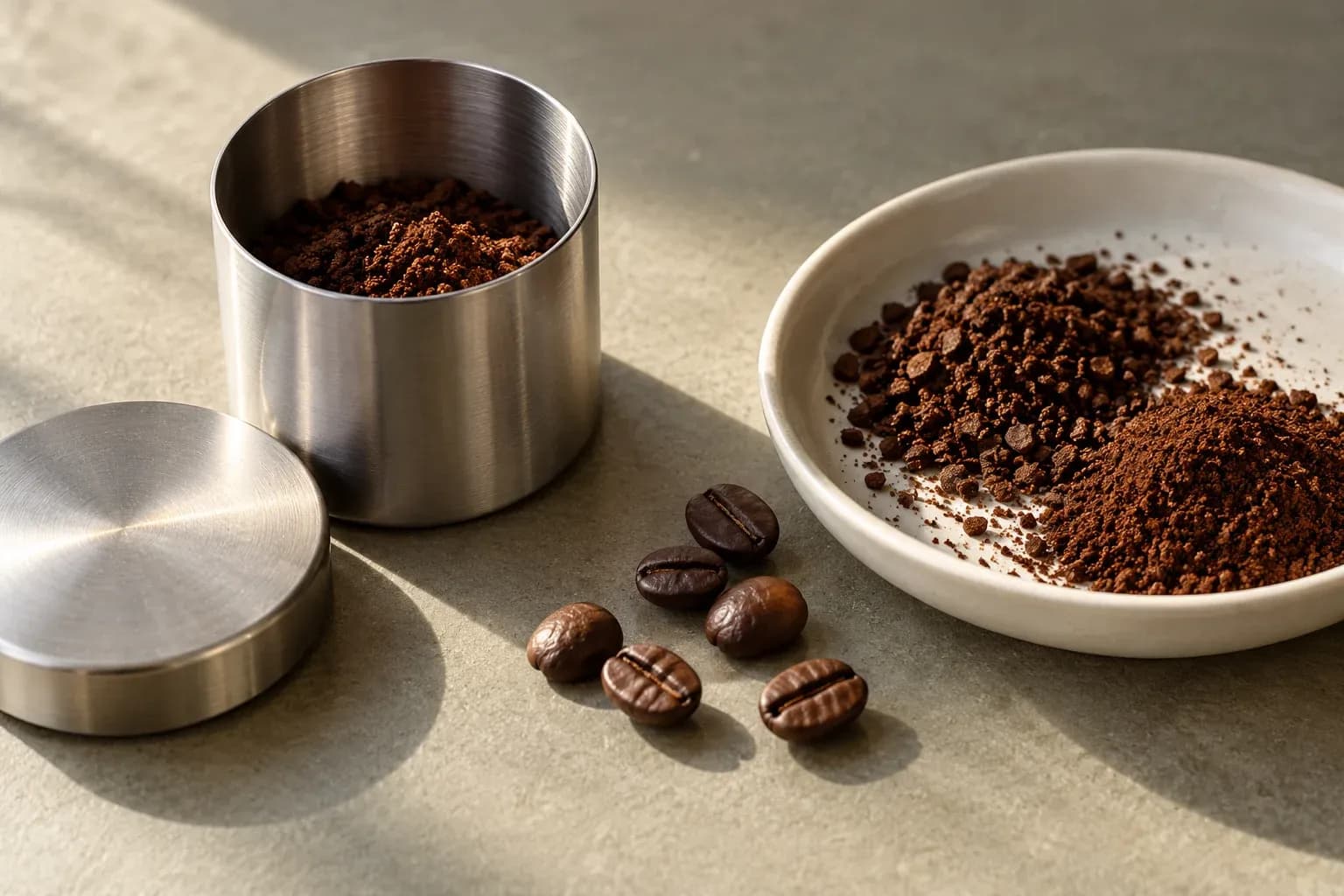
A grinder produces a range of particle sizes rather than one perfectly uniform size. The small particles usually called fines are part of that distribution. The precise size boundary depends on how the particles are defined and measured, so “more fines” is an incomplete statement without a measurement method.
Fine particles have a large surface area relative to their mass. They also influence how a packed bed admits water. In espresso, their arrangement can change hydraulic resistance; in paper-filtered coffee, their movement towards the filter can affect drainage. This is why faster extraction from individual small particles can coexist with slower flow through a bed.
That does not make fines inherently undesirable. Removing part of the size distribution changes the dose and the material being brewed. The useful question at home is usually whether a preparation step makes your coffee taste better and your routine more consistent, not whether the grounds look free of small particles.
Declumping is not the same as removing fines
When a clump breaks apart, its constituent particles are still in the cup unless some are left on the walls, escape into the air or are deliberately separated. Shaking a sealed container does not make fine material vanish.
Nor does it guarantee uniform mixing. Particle mixtures can rearrange under movement. The result depends on container shape, fill level, particle properties and the direction and duration of the motion. Transferring the grounds afterwards adds another rearrangement. A claim that shaking always sends fines to one particular place goes beyond what you can infer from the finished pile.
Keep a second distinction in mind. Static electricity can make grounds adhere to a surface; mechanical movement can dislodge some of them. A cleaner cup after shaking may indicate better transfer, while a changed shot may reflect a different delivered dose. You need the scale to tell these possibilities apart.
Weigh what reaches the brewer
Suppose you weigh 18 g of beans before grinding. That is not proof that 18 g reaches the espresso basket. Some coffee may remain in the grinder, dosing cup or transfer tool. Conversely, previously retained grounds can join the current dose.
For a comparison of preparation methods, weigh the grounds actually delivered to the basket. If one routine delivers 17.6 g and another delivers 18.0 g, you changed the dose as well as the movement. The figures here are an arithmetic example, not measured results from a test.
If your aim is to evaluate the whole workflow, it is reasonable to include transfer losses in the outcome. Just describe that test differently. “This routine delivers my weighed dose more consistently” is a narrower and more useful conclusion than “shaking improved extraction.”
Give the movement a definition before testing it
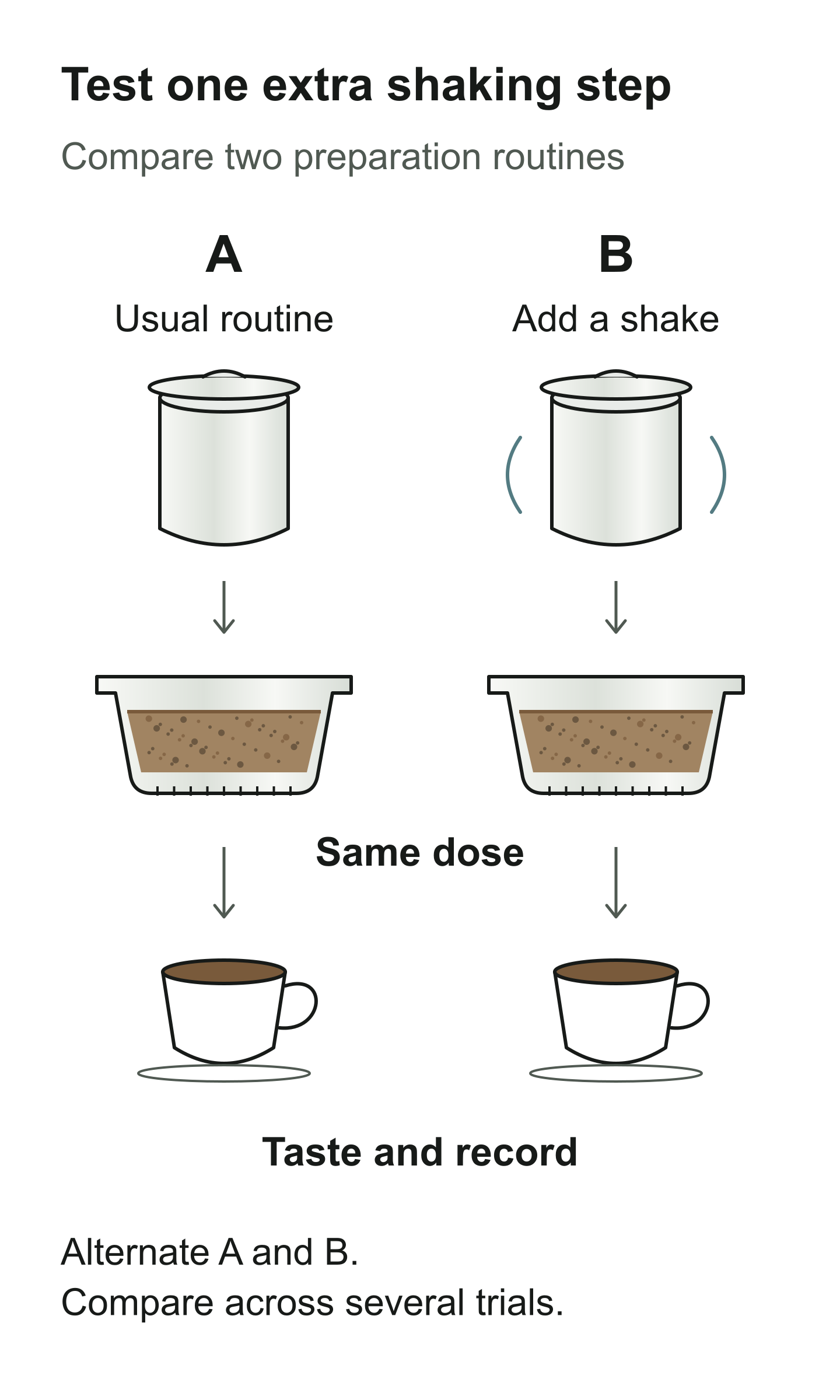
Use a clean, dry, food-safe container with a secure lid. Leave enough space for the grounds to move and stay within the intended use of the dosing equipment. Choose one movement you can reproduce, such as five gentle side-to-side movements with the container closed. That is an illustrative test condition, not a universal shaking prescription.
Compare it with your normal transfer at the same delivered dose. Keep coffee, grind, basket, distribution after transfer, tamping and beverage target fixed. Alternate the order and repeat several pairs. Changing grind immediately after the first unusual shot prevents you from seeing whether the preparation step has a repeatable effect.
Record the delivered dose, visible transfer residue, beverage mass, time and taste. If you normally use a needle tool after transfer, keep using it in both routines. Otherwise the comparison includes both shaking and removal of a later step.
Read a changed flow without inventing its cause
A slower shot means the system's flow changed under those conditions. It does not tell you exactly where the fines moved. A faster shot is equally incomplete evidence. Taste, repeatability and the preparation record are needed to decide whether the change is useful.
For filter coffee, compare the same dose, paper, water and pouring pattern. If shaking is followed by a longer drawdown, first check that transfer and agitation during brewing stayed comparable. A different mound in the dripper may alter initial wetting even if the total dose is identical.
If the only consistent benefit is less coffee sticking to the container, that can still be worth keeping. If taste is unchanged and preparation takes longer or creates more mess, there may be little reason to add the step. A routine earns its place by solving a problem you actually have.
Choose a different tool when the problem is different
For visible clumps in an espresso basket, a controlled distribution routine targets the bed more directly than assuming a closed cup mixed everything evenly. For grounds clinging to the grinder outlet, investigate static and transfer. The guide to static control and distribution explains why those are separate jobs.
If drainage is the issue, inspect grind, paper seating and brewing agitation before trying to eliminate fines by eye. You cannot determine a particle-size distribution from the appearance of a pile. You can determine whether a clearly described change produces a cup you prefer, with less variation and less wasted coffee.