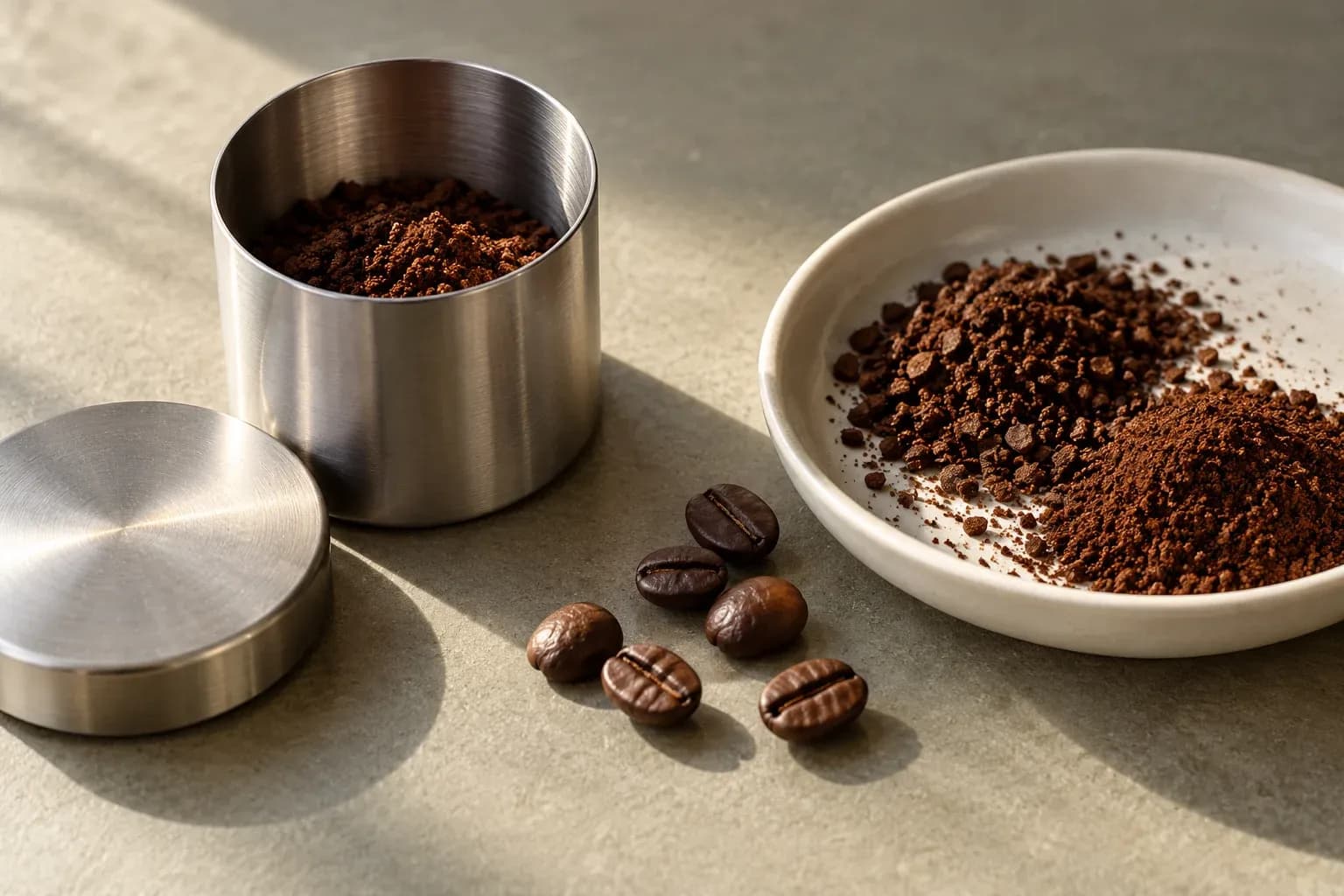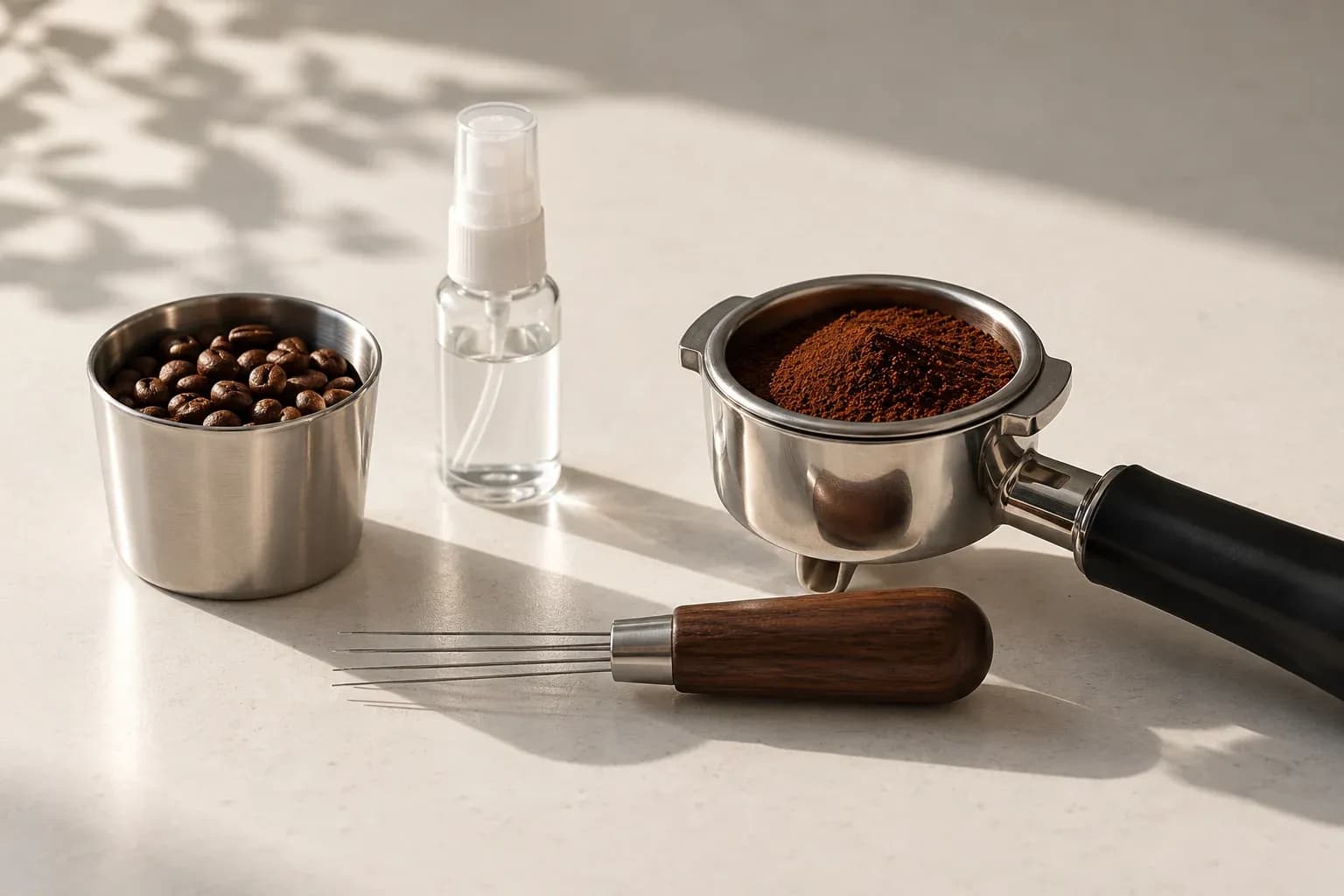
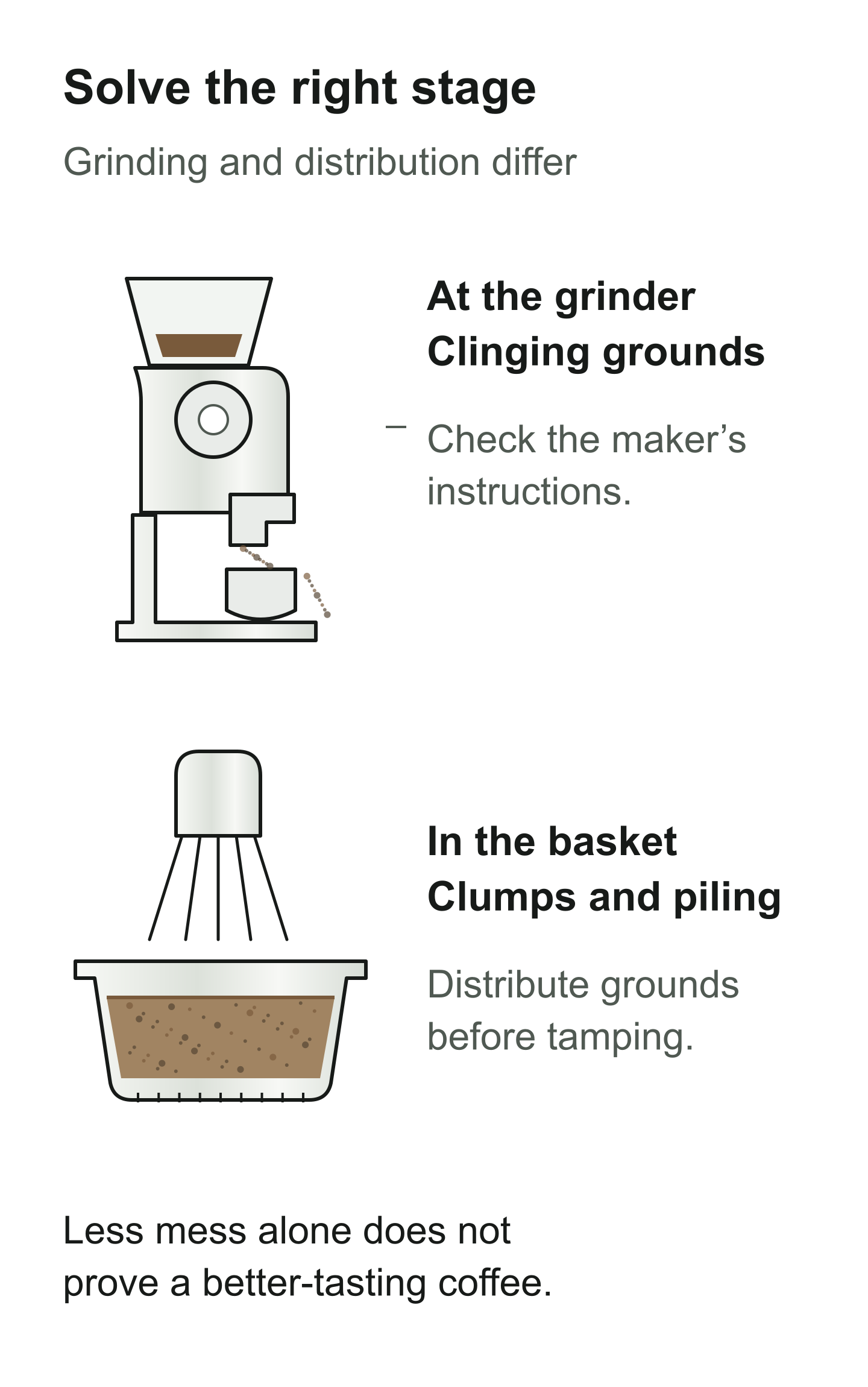
Grounds cling to the dosing cup, while the espresso in the basket still contains visible clumps. Both problems appear before tamping, so it is easy to look for one tool that will fix everything. They happen at different points in the workflow and need different checks.
A small water treatment before grinding is commonly called the Ross Droplet Technique, or RDT. A needle distribution tool works on the grounds after grinding. An automated needle device changes how that second action is performed. None of these labels tells you that the other steps are no longer necessary.
Static begins before the basket
Grinding involves particles breaking, rubbing and separating against other particles and equipment surfaces. Electrical charge can develop during those interactions. Charged grounds may cling to parts of the grinder or receiving vessel, making transfer messy and the delivered dose less predictable.
The behaviour depends on the coffee and the conditions. Roast, moisture, grinder design and the surrounding environment can all change what you observe. One setting that works with one coffee is not evidence for a universal water dose or an identical response on another grinder.
Static is also only one reason coffee remains inside a grinder. Its geometry can trap grounds mechanically. Reducing cling at the outlet does not prove that every internal retention space is empty, and a clean-looking counter is not a measurement of extraction.
What adding a little water can and cannot establish
Water added to beans before grinding can change charging and clumping during grinding. In practice, it may reduce visible cling in some setups. The relevant question is whether it improves your transfer at a suitable, repeatable treatment, with your equipment.
Check the grinder manufacturer's guidance before wetting beans. Some manufacturers specify a method or limit; others do not support this practice. Do not spray into the grinder, apply water to electrical parts or improvise an amount from someone else's equipment. Where the manufacturer permits bean treatment, use its stated method and avoid leaving wet beans sitting in a hopper.
A count of sprays is not a precise dose. Spray heads differ, and a full trigger stroke can deliver a different mass from a partial one. If you need to compare treatments quantitatively, the measuring device must resolve the amount you are trying to measure. A kitchen scale that reads whole grams cannot reliably quantify a tiny application.
For everyday use, consistency and manufacturer compatibility matter more than pretending to have a precise water number. Keep the procedure simple enough that you can repeat it without soaking the coffee or the receiving tools.
Distribution works on the bed you will brew
A needle tool moves through ground coffee in the basket. A controlled pattern can break visible clumps and redistribute the grounds before tamping. Its job is about the arrangement of the bed, not removing charge from beans before they enter the grinder.
An automated needle device offers a defined motion, but its setup still matters. Needle depth, basket fit, dose and whether the tool reaches the intended parts of the bed affect what it can do. Follow the device's instructions; a programmed movement is not proof that every basket and dose receives equivalent treatment.
After distribution, use the same settling and tamping routine. If you knock the portafilter heavily or rake the surface differently each time, those later movements can obscure what the distribution step contributed. The guide to a level tamp covers how to keep that final preparation stage easier to interpret.
Locate the loss before buying another tool
Start with a simple mass check. Weigh the beans going in, the grounds leaving the grinder and, where practical, the grounds reaching the basket. Do not infer the final basket dose from the input alone. Residue inside the grinder and residue left in the dosing cup are different parts of the transfer.
If the counter is messy but the basket dose and shots are consistent, the problem may be cleanup rather than cup quality. If the delivered dose varies, address transfer first. If the dose is stable but the bed contains clumps or shots vary despite a stable recipe, inspect distribution and tamping next.
Keep the grinder's cleaning state comparable during a trial. Immediately after a thorough clean, empty retention spaces may behave differently from the grinder in its ordinary working state. Changing cleaning, water treatment and distribution together makes the outcome difficult to attribute.
Compare two interventions with four clearly defined routines
If you want to separate their effects, use four conditions. Begin with your normal dry grinding and normal basket preparation. Compare that with the same routine plus manufacturer-permitted water treatment, then with dry grinding plus one defined needle routine. Finally, try both interventions together.
Keep the coffee, delivered dose, grind, basket, tamp, temperature setting and beverage target stable. Alternate conditions in a practical order and repeat them rather than treating one shot per condition as a ranking. Record transfer residue, delivered mass, shot time, beverage mass and a brief taste note. Evaluate convenience too, including cleaning and extra handling.
This comparison asks how the steps behave at one grind setting. Once you select a workflow, dial in that workflow for taste. Keep those phases separate so a grind change does not masquerade as an improvement from the tool.
Keep the smallest routine that solves the observed problem
Less visible static can justify a treatment because it reduces mess or improves transfer. More even preparation can justify a distribution step because results become easier to repeat. Neither observation on its own proves higher extraction or better flavour.
If you see no repeatable benefit, leave the extra step out. If one step helps transfer and another helps preparation, they can coexist. The useful decision is which stage needs attention in your own routine, with evidence from the dose, the process and the cup.